


A fire breaks out in your office kitchen. The alarm sounds. Does everyone know where to go? Is there someone trained to lead them there? And if a regulator ever asked, could you actually prove your procedures hold up? These aren’t abstract questions anymore. In 2026, they’re legal obligations and the gap between businesses that can answer them confidently and those that can’t is wider than most owners realise.
The Threat Picture Has Changed Shape
Ask most business owners what “security” protects them from and the answer is usually theft or vandalism. That’s no longer the full picture. Research from the British Chambers of Commerce found that 42% of UK businesses experienced some form of crime in the past year, with the risk climbing sharply by size from around a third of micro-businesses up to well over half of firms employing more than 250 people. Manufacturing was hit hardest of all, with half of firms in the sector reporting business crime.
At the same time, the government’s most recent Cyber Security Breaches Survey found that 43% of UK businesses experienced a cyber breach or attack in the past 12 months, roughly 612,000 organisations, accounting for an estimated 5.19 million individual cybercrimes. Yet only 31% of businesses have board-level ownership of cyber security and fewer than one in five even review the risk posed by their immediate suppliers. As one industry commentary on the survey put it, cyber security is still too often treated as a purely technical matter, taken seriously only once something has already gone wrong.
Layer fire safety obligations on top of that, including new rules that came into force on 6 April 2026 requiring Personal Emergency Evacuation Plans for residents who may need assistance and it becomes clear why “security” can no longer mean a single guard, a single system, or a single department.
Why Separating These Risks No Longer Works
Here’s the uncomfortable part many businesses haven’t caught up to: these threats don’t stay in their own lanes anymore. Physical intrusion, cyber compromise, insider risk and even protest activity increasingly target the same high-value assets, sometimes as part of the same coordinated event. A break-in that looks like simple opportunism might be reconnaissance for something larger. A disgruntled employee’s access badge is as much a cyber risk as it is a physical one.
Treating fire safety, physical security and cyber protection as three unrelated checklists is a bit like treating a building’s plumbing, wiring and structural frame as separate concerns that never interact. They’re designed and inspected together for a reason because a failure in one rarely stays contained to just that one.
Fire Marshals: The Legal Backbone Businesses Often Underestimate
Fire safety is a useful example of how “compliance” and “protection” have quietly merged. Under Article 18 of the Regulatory Reform (Fire Safety) Order 2005, every UK workplace’s Responsible Person must appoint competent people to help carry out preventive and protective fire safety measures. The legislation never actually uses the word “fire marshal,” but in practice, appointing trained marshals is how the vast majority of businesses meet this duty.
A properly trained fire marshal’s job splits into three phases. Day to day, it’s prevention: checking escape routes stay clear, fire doors aren’t wedged open, extinguishers haven’t been moved or tampered with and new starters actually know the evacuation procedure rather than guessing at it. During an incident, it becomes response: raising the alarm, leading an evacuation calmly, sweeping toilets and meeting rooms to confirm everyone’s out, running a headcount at the assembly point and knowing when it’s safe to tackle a small fire versus when it’s time to simply get everyone clear. Afterwards, it’s review, feeding what happened back into the plan so the next drill, or the next real incident, goes better than the last.
We used to think of fire marshal coverage mostly in terms of headcount; one trained person somewhere in the building felt like enough. It isn’t. Guidance generally points to at least one marshal per 15 to 50 people depending on your risk level, at least one per floor and enough overlap to cover holidays and sickness without leaving a shift uncovered. Get the number wrong and you can be technically “compliant” while still having nobody available on the one afternoon it actually matters.
What Non-Compliance Actually Costs
The penalties attached to fire safety failures aren’t symbolic. Minor breaches can carry fines of up to £5,000; major ones carry unlimited fines and up to two years in prison, alongside enforcement or prohibition notices that can shut premises down with little notice. Set against that, the cost of trained, professional fire marshal cover looks less like an expense and more like insurance that happens to also keep people alive.
Where Professional Services Outperform In-House Arrangements
It’s tempting to handle fire marshal duties internally: nominate a willing employee, run a short briefing, tick the box. The problem is consistency. In-house arrangements tend to work well right up until the trained person is on holiday, changes role, or simply forgets a detail they learned once and never revisited. Professional providers train to a certified standard, refresh that training annually and can guarantee coverage across every shift rather than hoping the right person happens to be in the building.
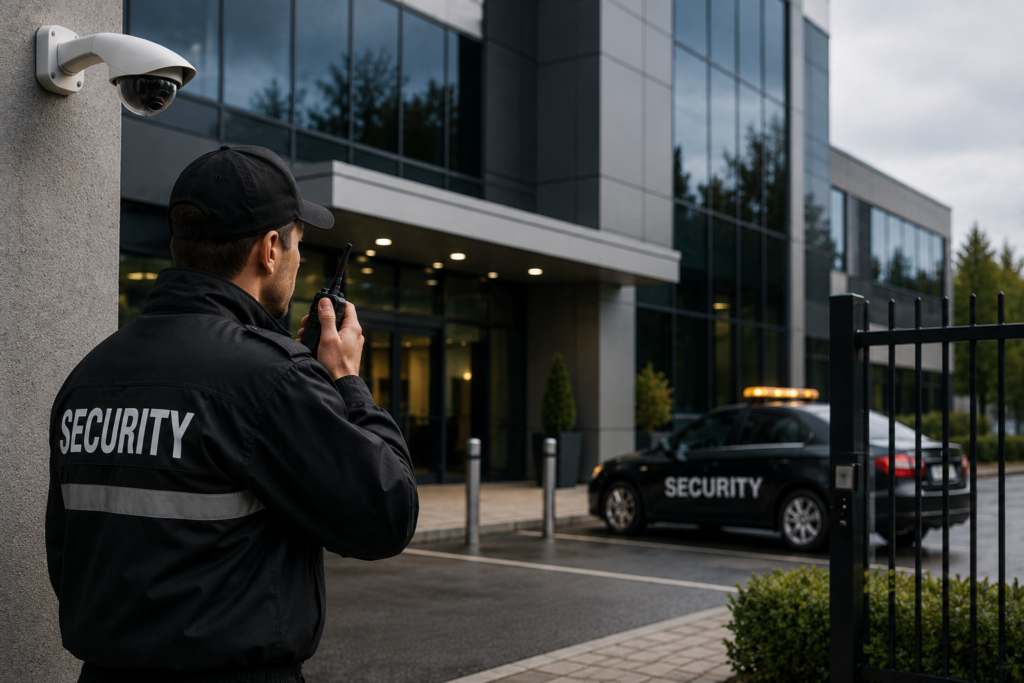
The same logic extends across security more broadly. Manned guarding / static guarding provides a visible, trained presence that deters opportunistic crime before it starts. Keyholding & alarm response services ensure that when an alarm does trigger day or night, a trained professional, not an untrained employee, is the one attending. Combined with dedicated fire marshals, these services stop functioning as separate line items and start working as one coordinated response to whatever actually happens on site.
Building a Multi-Layered Defence
None of this means every business needs every service at once. It means treating security as a layered system rather than a single purchase. A fire risk assessment identifies what your building actually needs. A review of physical vulnerabilities, access points, out-of-hours coverage and alarm response times identifies the rest. From there, a provider offering integrated security services can align fire safety, guarding and emergency response under one plan instead of three disconnected contracts that only get compared after something’s gone wrong.
A Practical Next Step
Start with the fire risk assessment you’re legally required to have if it’s out of date; that’s the first gap to close. Confirm who your Responsible Person is, calculate how many trained marshals your risk level and floor plan actually require and check whether your current arrangements would hold up if a fire inspector walked in tomorrow. Then look sideways at physical security: are your alarms monitored by someone trained to respond, or just someone who happens to be nearby?
The businesses weathering 2026’s threat landscape well aren’t the ones spending the most on security. They’re the ones who stopped treating fire safety, guarding and emergency response as separate boxes to tick and started treating them as one connected plan built by people trained to run it, not assembled at the last minute after something’s already gone wrong.
Yes. The Regulatory Reform (Fire Safety) Order 2005 requires every business to appoint competent persons to help implement fire safety measures. Trained fire marshals are the standard way businesses meet this duty.
It depends on risk level: roughly one per 50 people for low-risk premises, one per 20 for medium risk and one per 15 for high-risk environments, plus at least one per floor and enough cover for holidays and sickness.
None, legally. The terms are used interchangeably in UK practice, though some employers use “fire marshal” for the person with overall responsibility and “fire warden” for assistants.
Penalties range from fines of up to £5,000 for minor breaches to unlimited fines and up to two years in prison for major ones, alongside possible enforcement or prohibition notices.
Professional Facilities Management
Security, compliance, maintenance, and support all delivered with professionalism and accountability by the team you can rely on.
Speak to Our Team