


A fire alarm that quietly tests itself at 3 AM, without waking a single person in the building. A detector that can tell the difference between burnt toast and a genuine fire. A virtual copy of your building where a fire scenario can be run and studied before anything actually burns. None of this is speculative. It’s the state of fire safety technology heading into 2026, and it’s already changing what “compliant” and “protected” actually mean.
If you own, manage, or maintain a commercial building, this shift affects you directly, not in five years, but this year.
Why Fire Safety Is Being Rebuilt From the Ground Up
Across Europe, fire protection is going through what industry bodies describe as a genuine turning point, with digital connectivity, remote monitoring, and cybersecurity converging into a single, redesigned approach to how buildings are protected. Detection systems that once sat quietly until triggered are now part of a connected, always-on layer of building infrastructure.
There’s a practical reason this matters beyond the technology itself. Environmental pressures hotter summers, drier conditions, and a general rise in fire risk are pushing preparedness from a professional nicety into something closer to a baseline expectation. At the same time, regulatory scrutiny in the UK has tightened considerably. The cost of falling behind, whether through fines, insurance penalties, or something far worse, has never been higher.
From Reactive Alarms to Connected, Self-Checking Systems
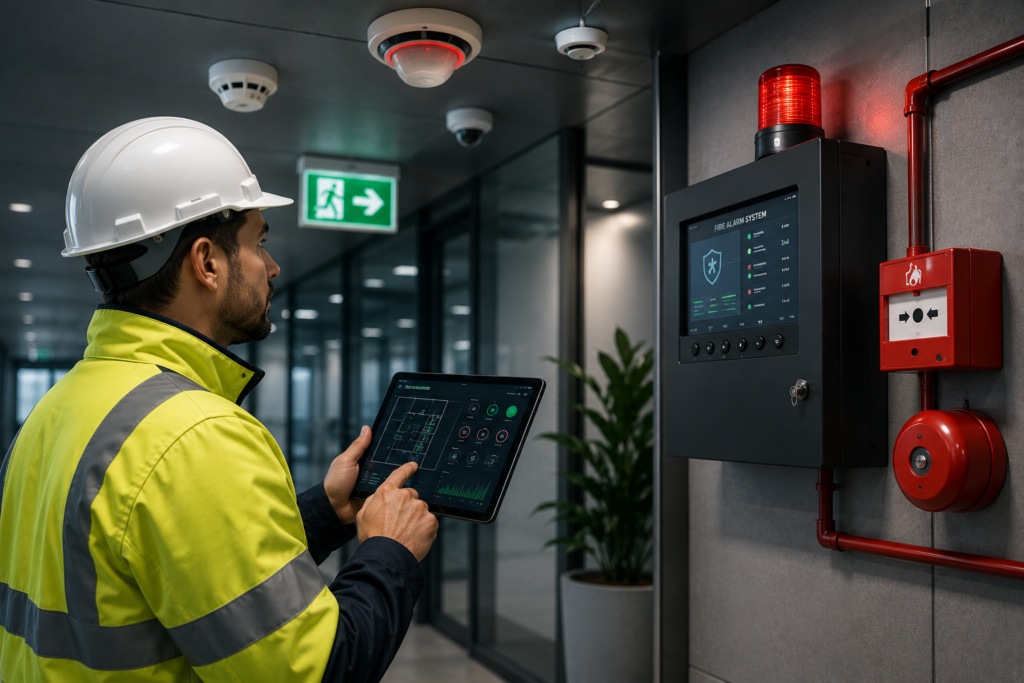
For most of fire safety’s history, a detector’s job was simple: sit still, sense smoke or heat, sound an alarm. Testing happened periodically, usually by a technician walking the building with a checklist. That model is being replaced by devices that check themselves, continuously running disturbance-free diagnostics in the background, without triggering horns or strobes and report their own status to a facility manager’s screen in real time.
Siemens‘ newer detector portfolios, launched in 2026, illustrate the direction clearly:
- 24/7 automated self-checks
- Live monitoring of smoke entry points
- Cloud connectivity that supports predictive maintenance
All while remaining compatible with the fire panels many buildings already have installed. So an upgrade doesn’t mean ripping out the entire system. One Siemens fire safety lead described the goal as moving away from periodic inspection toward continuous self-supervising systems. That laid the groundwork for genuinely autonomous buildings.
Think of the difference like the shift from an annual health check-up to a fitness tracker worn every day. Both can catch a problem, but one only catches it if the problem happens to fall on the day of the appointment.
Smarter Sensors, Fewer False Alarms
If there’s one number that captures why intelligent detection matters. It’s this: in some countries, over 85% of fire alarm activations turn out to be false. That’s not a minor inconvenience. Every false alarm disrupts:
- Operations
- Wastes emergency service time
- Over enough repetitions, trust in the system meant to keep people safe depletes
Multi-sensor detection is the industry’s answer. Rather than relying on a single input, newer devices combine multiple optical wavelengths with thermal sensing to separate genuine fire signatures from dust, steam, or cooking smoke. Research into near-infrared detection has shown that this multi-wavelength approach is genuinely necessary for reliable performance in environments where non-fire particles welding fumes, vehicle exhaust, general dust are common. Separately, researchers have tested systems that combine visual detection with audio cues, such as the crackle of flame. To maintain accuracy even in low light, where cameras alone tend to struggle.
We’ll be honest: for a long time, we treated a “sensitive” detector and a “reliable” one as roughly the same thing. They’re not. A detector that alarms too easily doesn’t make a building safer; it just trains occupants to expect false alarms, which is its own kind of risk. The real advance in 2026 isn’t sensitivity. It’s discernment.
Cloud Monitoring Is Changing How Buildings Get Managed
Cloud-connected fire systems now allow facility teams to check the health of every device across a site or a portfolio of sites without a single physical inspection. Remote diagnostics catch failing components before they become failures, and predictive maintenance means engineers are dispatched because data suggests something needs attention, not on a fixed calendar.
One of the clearer illustrations of this comes from a cloud-enabled fire safety deployment across eight prisons in Ireland, where staff could assess a developing situation and decide from a smartphone app whether a full evacuation was necessary or whether a phased, more controlled response would do. In a high-security, high-occupancy environment, that distinction matters enormously; an unnecessary full evacuation carries its own operational and safety risks.
Digital twin technology takes this further still, letting a fire safety system be tested virtually, simulating how smoke would spread, how an evacuation would unfold before anything is finalised on paper, let alone installed.
What’s Changing in UK Regulation
Compliance requirements are moving in step with the technology. From 6 April 2026, the Fire Safety (Residential Evacuation Plans) (England) Regulations require responsible persons to identify residents who may need help evacuating and agree written Personal Emergency Evacuation Plans (PEEPs) with those who request one. Fire risk assessments must now be formally recorded, naming the responsible person and documenting significant findings and actions a paperwork requirement, but one regulators are enforcing closely.
Separately, a consultation on updates to Approved Document B closed in June 2026. Covering evacuation lifts in taller residential buildings, restrictions on combustible cladding materials, and revised guidance on external wall fire spread. Whatever the outcome, it signals where enforcement attention is heading next.
Inclusive Evacuation and a Word on Sustainability
Emergency communication is also becoming more considered.
- Voice guidance for occupants who struggle to navigate unfamiliar floor plans
- Captioned alerts for those who are hard of hearing
- Messages tailored to specific floors rather than blanket building-wide announcements
These are increasing standard in new systems, a meaningful shift from the one-size-fits-all siren.
Sustainability has found its way into fire safety too, somewhat unexpectedly. Detectors built from recycled plastics, energy-efficient notification devices, and fewer engineer call-outs thanks to remote diagnostics are becoming selling points in their own right, not afterthoughts.
What This Means for Cybersecurity
Every connected fire detector is also, technically, a network device and that brings a responsibility that didn’t exist in the analogue era. Industry standards such as IEC 62443 for operational technology and ISO/IEC 27001 for information security are now directly relevant to fire safety procurement, not just IT departments. A “Security by Design” approach where protection is built in rather than added on is becoming the expected baseline for any connected system protecting a building.
A Practical Starting Point
You don’t need to overhaul everything at once. Start by reviewing whether your current fire risk assessments are formally recorded and up to date, checking whether your detection systems support remote diagnostics, and confirming your PEEPs are in place if your building falls under the new residential evacuation requirements. From there, an audit by a qualified fire marshal team can identify exactly where legacy equipment or outdated procedures leave you exposed, often well before an inspector does. For buildings where fire safety sits within a broader risk picture, pairing this with our wider facility management services or standalone security services ensures nothing falls through the gap between departments.
The direction of travel is clear: buildings that detect problems earlier, communicate more precisely during an emergency, and can prove their compliance on paper are the ones that will weather both audits and actual incidents with far less disruption. The technology to get there already exists. The only real question is how soon you put it to use.
Connectivity. Detection systems are moving from standalone alarms to connected infrastructure capable of continuous self-testing, remote diagnostics, and predictive maintenance.
By combining multiple detection methods optical, thermal, and sometimes audio instead of relying on a single sensor type, systems can distinguish genuine fire signatures from dust, steam, or cooking smoke far more reliably.
Personal Emergency Evacuation Plans are written agreements for residents who may need assistance evacuating. Since April 2026, responsible persons for qualifying residential buildings in England must identify those residents and agree plans with them.
Not usually. Many current systems are designed to work alongside existing fire panels, allowing a stepwise upgrade rather than a full replacement.
Professional Facilities Management
Security, compliance, maintenance, and support all delivered with professionalism and accountability by the team you can rely on.
Speak to Our Team