


You wake up at 3:00 a.m. Your cell phone rings on the nightstand. You’re asleep. The time it takes you to stir, unlock the phone, load the app and determine if the activity is a burglary or just a curtain blowing in the wind. Whoever triggered the alarm has already gone and quite possibly taken something with them. This is happening every night in the week in the UK. The question is, did you have an alarm that detected the problem? It’s who could have done something about it.
Two Systems, One Very Different Question
Get rid of the marketing and the specs of the equipment and the only difference between a professional alarm response system and self-monitoring is who gets the alert first and who has to take action on it.
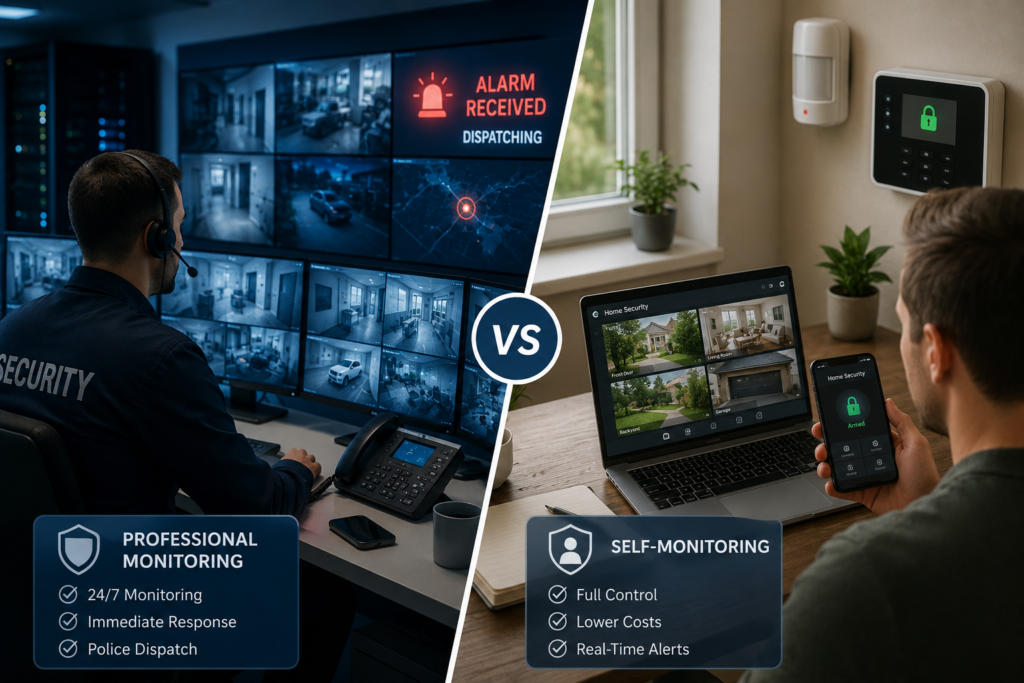
Under the professional alarm response, a trained man at a manned Alarm Receiving Centre (ARC) receives the signal and can automatically send help, regardless of whether or not you are available 24/7. Self-monitoring means that the system notifies you directly via an app alert, a text, an email and you then have to evaluate what you are seeing, determine if it’s real and contact emergency services on your own.
It’s good to pause for a moment and remember that while you might think that the better the sensors, the better the protection, that is not always the case. They do not, per se. If the alert is delivered to the wrong person or too late to be of any use, the sensor might do its duty perfectly, yet the alert would not help you. The most important part of your security system is what happens in the few seconds after it goes off.
What Actually Happens When the Alarm Sounds
The process of professional monitoring is pretty standard: the sensor triggers, the signal gets to the ARC in a few seconds, they look at the event and, if possible, cross-check the live camera feed, try to confirm what they see and notify emergency services if the threat appears real or the property owner is unavailable. You do not need to do anything at that time.
Some ARCs perform at a level worth noting here. Glasgow City Council’s monitoring centre, for example, responds to 99.6% of fire alarms and 99.2% of intruder alarms within 90 seconds a benchmark that gives a sense of what a well-run, NSI-accredited operation can achieve.
The self-monitoring chain is longer and more brittle: a sensor activates, a notification appears on the user’s smartphone, they have to be available, awake and fully capable of mind to open the app, read a clip, decide if it’s real and make the call themselves. When you are in the middle of a meeting, on a flight, out of signal range or just one too many false alarms in a week, the whole chain comes to a halt. Not because the technology was not up to scratch, but because the one link that relies on YOU wasn’t there.
What This Actually Costs in 2026
Cost is usually the first question people ask and it’s a fair one. Self-monitoring typically runs £8–£15 a month, covering app alerts with no central station behind them. Basic professional monitoring sits at £15–£30 a month for single-path signalling to a 24/7 ARC, while comprehensive packages dual-path signalling, smartphone integration and video verification land around £30–£60 a month. On top of that, expect installation costs of roughly £800–£1,500 for a monitored residential system, or £800–£5,000+ for commercial systems depending on grade.
Here’s the part that’s easy to miss: self-monitoring isn’t free once it’s running. You become the dispatcher, the record-keeper and the after-hours responder, which costs time even when it doesn’t cost money. A low headline price isn’t the same thing as a low lifetime cost and plenty of businesses only work that out after an incident, not before. Many small businesses also assume professional monitoring sits well outside their budget, but a comprehensive package now often costs less per month than a single engineer callout.
Redundancy: The Part Nobody Thinks About Until It Fails
Self-monitored systems that lean entirely on home broadband and app notifications are, frankly, brittle. If your internet drops, if your phone is silenced, if you’re simply out of range, you don’t get the alert. There’s no backup layer, because you are the backup layer.
Professional monitoring is generally built with redundancy baked in: cellular signalling that kicks in if broadband fails, supervised communication so the ARC knows the moment a connection drops and battery backup so the system keeps working through a power cut. Think of it the way you’d think about a spare tyre. You don’t need it most days. The one day you do, its absence is the only thing that matters.
Police Response Isn’t Automatic And That Surprises Most People
This is where a lot of assumptions fall apart. In the UK, police attendance at a triggered alarm is not a given. It’s governed by the National Police Chiefs’ Council (NPCC) Security Systems Policy and only systems that meet specific criteria qualify for automatic dispatch.
To get there, your system needs to be installed by an NSI Gold, NSI Silver, or SSAIB-approved company, comply with the PD 6662 standard and be registered with a Unique Reference Number (URN) that links your premises to police systems. Without that URN, police won’t automatically attend; you’d need to dial 999 yourself and report a crime in progress, the same as anyone without a monitored system at all. Self-monitored DIY setups, however good the hardware, generally can’t obtain a URN.
False alarms complicate this further. Under NPCC policy, three false activations within a rolling twelve-month period can see a URN downgraded, meaning police stop attending until the issue is resolved and the system is recertified. Traditional sensor-only systems without visual context are prone to setting off false alarms at a striking rate, which is exactly why video verification, where an ARC operator checks live footage before dispatching anyone, has become such a meaningful safeguard rather than a nice-to-have extra.
We’ll be candid about something here: for years, plenty of alarm providers, this one included, early on treated URN eligibility as a footnote rather than a headline feature. It shouldn’t be. For a business, it can be the difference between police turning up in minutes and a break-in that no one in uniform hears about until you report it yourself.
Weighing the Two Side by Side
Professional alarm response offers 24/7 staffed coverage, automatic dispatch with no action required from you, cellular and battery redundancy, URN eligibility through accredited installers and stronger insurance recognition at a higher monthly cost and typically a contract commitment. Self-monitoring offers lower fees, full control and no lock-in but leaves you as the single point of failure, without URN eligibility and with response times that depend entirely on your own availability in the moment.
Roughly half of homeowners with a security system cite peace of mind, not price, as the reason they chose it. That figure lines up with what we hear directly: people rarely regret paying for a monitored system after a genuine incident. They regret it when they didn’t.
So, Which Should You Choose?
If you travel a lot, you have a business that requires reliable after-hours coverage, you don’t have a hands-on mentality when it comes to your phone, you need URN eligibility, or you just want to let a trained professional handle the moment instead of you when you need it most, then a professional alarm response makes sense. Self-monitoring can be effective if you’re always available, feel like you’re your own first responder, can afford it and have a lower-risk property where it’s more important to be deterred than guaranteed to be dispatched.
The real question to ask yourself is “what does this cost? If it goes off at 3 a.m. and I don’t hear it, what happens next?
If the answer makes you uneasy, it’s likely the answer itself. Our keyholding & alarm response services team can explain to you what a NSI Gold-accredited, URN-eligible monitoring is like for your property and our mobile security patrols & lock-up services will complement your site where a physical presence is just as important as a quick response.
Who responds first. Professional monitoring routes the alert to a trained operator who can dispatch help automatically; self-monitoring routes it to you and you’re responsible for judging and acting on it.
No. Police response requires a Unique Reference Number (URN), which is only available for systems installed by NSI or SSAIB-accredited companies to PD 6662 standards.
Under NPCC policy, three false activations in a rolling twelve months can see your URN downgraded, meaning police stop attending until the fault is fixed and the system is recertified.
For businesses, frequent travellers, or anyone who wants a guaranteed response when they’re unavailable, most find the monthly cost worth it, particularly given potential insurance discounts and URN eligibility.
Professional Facilities Management
Security, compliance, maintenance, and support all delivered with professionalism and accountability by the team you can rely on.
Speak to Our Team