


Think about the effort you put into organising a big event over the course of a year, selling thousands of tickets, securing performers, enlisting suppliers and getting the arrangements perfect. Only to find that your security arrangements no longer satisfy current expectations. It’s a reality for many event organisers in 2026.
Live events are making a comeback across the UK. Growing numbers of people are coming to festivals, sports events, corporate events, exhibitions and community events, and they’re doing so in increasingly complex environments. Meanwhile, however, security requirements have shifted significantly.
No longer do you have to only hire guards and assign them at entrances. You must have an understanding of crowd behaviour, risk analysis of terrorism, safeguarding attendee information, emergency plans, and current legislation.
Many organisers now rely on professional event security services to manage increasingly complex risks. This year brings significant developments, from Martyn’s Law and SIA training changes to artificial intelligence, biometric entry systems, drones, and cyber risks. Understanding these trends now will help you protect your attendees, satisfy regulators, and deliver safer events.
Martyn’s Law Changes the Security Conversation
No development has shaped UK event security more than Martyn’s Law.
The Terrorism (Protection of Premises) Act 2025 introduces legal duties for publicly accessible venues and events to improve preparedness against terrorist attacks. Named after Martyn Hett, who lost his life during the Manchester Arena attack, the legislation represents the biggest shift in venue security requirements for a generation.
The Home Office published final guidance in 2026, while enforcement is expected from Spring 2027. For many organisers, the challenge is not simply understanding the law. It is recognising that their event may fall within its scope.
Events expecting between 200 and 799 people will fall within the standard tier, while those expecting more than 800 people will fall within the enhanced tier. That calculation includes staff members, contractors, and attendees. Many organisers assume their capacity is lower than it actually is.
The Four Procedures Every Event Needs
Under the standard tier, you are expected to establish procedures for:
- Evacuation
- Invacuation
- Lockdown
- Communication
These procedures cannot remain inside a risk assessment folder. They must be understood by your team. They must be tested. They must work during a real incident. The Home Office guidance makes it clear that written plans alone do not protect people. Prepared staff do.
Security Personnel Are Becoming More Skilled
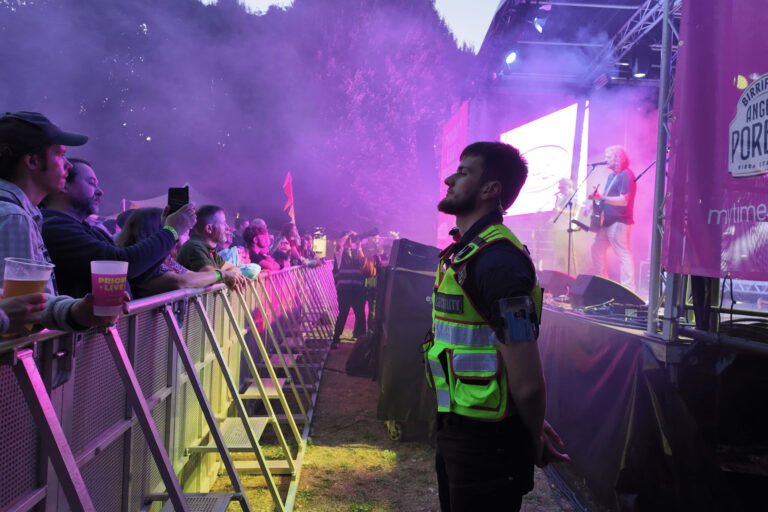
The traditional image of a door supervisor standing beside an entrance is becoming outdated. Today’s SIA door supervisors are expected to understand counter-terrorism awareness, conflict management, safeguarding, emergency response, and crowd psychology.
Mandatory refresher training requirements have reinforced this shift. Door supervisors renewing their licences must now complete updated qualifications that cover:
- Counter-terror awareness.
- Protecting vulnerable people.
- Search procedures.
- Emergency response.
- New legislation.
Training often appears expensive until it prevents an incident.
AI Is Becoming Part of Event Security
Artificial intelligence is beginning to influence how events are monitored and managed.
Large venues increasingly use AI-assisted systems to analyse live camera feeds and identify unusual activity. These systems can detect crowd density, monitor movement patterns, and flag potential risks before they escalate. The technology is impressive.
But the real value lies in giving security teams better information. Think of AI as a weather forecast rather than an autopilot. It can identify developing storms, but experienced professionals still decide what action to take. Some applications now include:
- Crowd density monitoring.
- Queue analysis.
- Suspicious behaviour detection.
- Predictive crowd movement.
- Restricted area monitoring.
Research published by the World Economic Forum and industry security specialists suggests that predictive analytics will continue expanding within large venues and public events. Yet technology remains a tool. Experienced manned guarding teams continue to make the final operational decisions.
Drones Are Providing a New Perspective
Larger venues sometimes combine drone monitoring with mobile patrol security and canine security teams to strengthen perimeter protection. Large festivals, agricultural shows, sporting events, and concerts often cover significant areas that are difficult to monitor from the ground. Drones are increasingly helping organisers gain visibility across:
- Car parks.
- Perimeter areas.
- Entry queues.
- Emergency routes.
- Congestion points.
Aerial footage can reveal developing issues that remain invisible at ground level. Several event operators have discovered overcrowding around secondary entrances simply by reviewing live drone footage. That ability to see the entire picture allows security teams to reposition staff quickly.
Biometric Entry Is Reducing Delays
Long queues create frustration. They also create security risks. Biometric technology and contactless access systems are becoming more common at larger events because they speed up entry while reducing ticket fraud. Facial recognition, identity verification, and digital ticketing can help organisers:
- Reduce counterfeit tickets.
- Improve access control.
- Shorten queue times.
- Verify authorised personnel.
- Strengthen VIP access systems.
Privacy concerns remain important, and organisers must ensure compliance with data protection requirements. Technology should improve attendee experience, not undermine trust.
Crowd Management Is Becoming Data-Driven
The safest crowds rarely happen by accident. Organisers increasingly use real-time information to understand how people move through venues.
The National Police Chiefs’ Council and professional sports organisations have invested heavily in analysing crowd behaviour because movement patterns often reveal risks before incidents occur.
We once overlooked how a food vendor location affected pedestrian movement at an event. The queue extended into a main access route, creating congestion that spread across the venue. The problem had nothing to do with security staffing. It was a crowd flow issue.
Good crowd management often solves problems before security interventions become necessary.
Cybersecurity Has Become an Event Risk
Event security no longer ends at the venue gates. Ticketing systems, registration platforms, attendee databases, and hybrid event technology all create digital risks. Cybersecurity experts increasingly warn that events can become targets for:
- Data theft.
- Payment fraud.
- Ticket scams.
- Deepfake impersonation.
- Platform disruption.
Research discussed at Infosecurity Europe 2026 found that many UK cybersecurity leaders believe artificial intelligence will significantly affect digital security over the next several years. If your event operates online registration, mobile applications, or hybrid streaming, cybersecurity should form part of your security planning.
Sustainability Is Influencing Security Decisions
Security planning now intersects with sustainability. Local authorities, venue operators, and event organisers increasingly consider environmental impacts when selecting suppliers.
This includes:
- Local staffing deployments.
- Reduced travel.
- Energy-efficient equipment.
- Digital ticketing.
- Reduced waste.
The assumption that stronger security automatically means more equipment and more personnel may no longer be accurate. Sometimes, better planning delivers both safer events and lower environmental impact.
The Door Supervisor Role Has Changed
The modern door supervisor performs multiple responsibilities. They may manage access control, operate technology, provide first aid, support vulnerable individuals, conduct searches, and respond to emergencies. Their role increasingly combines customer service and security.
Attendees remember how security staff made them feel. Professional officers create reassurance. Poor interactions create tension. The difference often determines how people perceive the entire event.
What Event Organisers Should Do Now
Waiting until 2027 is not a sensible strategy. You can begin preparing immediately.
Review Capacity Figures
Assess your expected attendance numbers carefully, including staff and contractors.
Document Procedures
Ensure evacuation, invacuation, lockdown, and communication procedures are written and understood.
Verify Licensing
Confirm that all SIA personnel hold valid licences and required refresher training.
Conduct Security Audits
Review your existing arrangements and identify weaknesses.
Evaluate Technology
Consider whether AI monitoring, access control systems, or crowd management tools may benefit your event.
Strengthen Cybersecurity
Review ticketing systems, data protection procedures, and digital platforms.
Work With Professional Security Providers
Experienced event security partners can help you understand changing requirements and prepare effectively.
Looking Beyond 2026
Event security is moving to an exciting new level. Martyn’s Law is transforming responsibilities under the law. The use of technology is enhancing awareness. Standards are being raised for training. Public demands keep growing.
The organisers who will make it over the next few years will not be the ones with the largest budgets. They will be those who are ready to make preparations. Security is no longer just about preventing incidents. It is about safeguarding persons, building trust, maintaining reputation and providing events that people will feel comfortable attending.
The year 2027 is fast approaching. Helping you to prepare now will allow you to adapt, train, review and improve before compliance is required. In 2026, there is no visible presence of good event security at the entrance. It’s the unseen and unheard backbone that makes your entire event successful.
Professional Facilities Management
Security, compliance, maintenance, and support all delivered with professionalism and accountability by the team you can rely on.
Speak to Our Team