


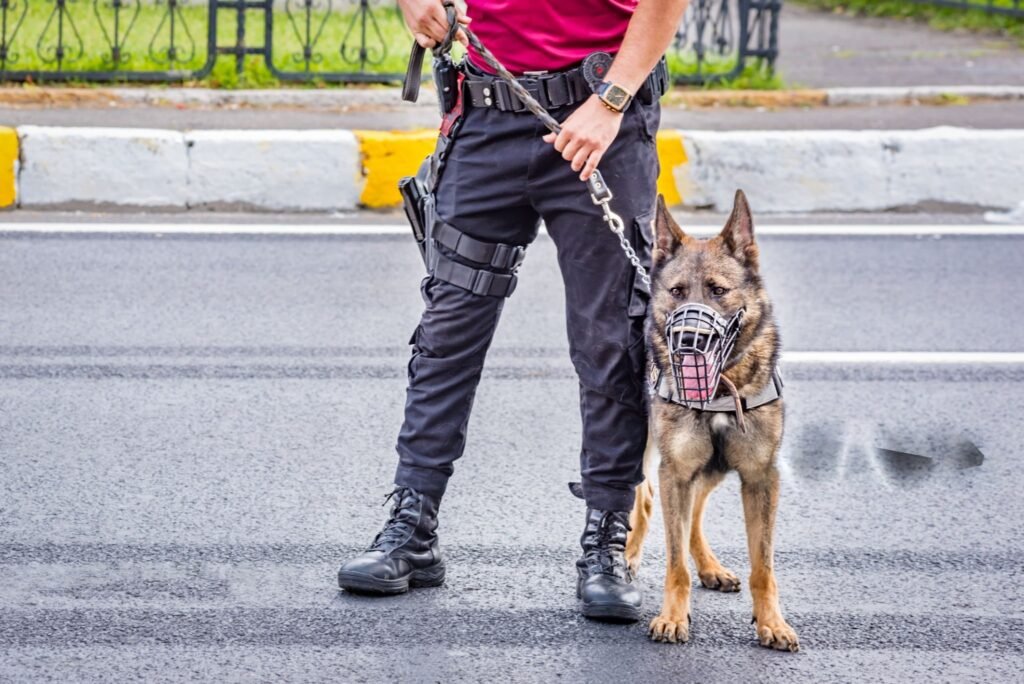
Imagine a building site at 2 am. Thousands of pounds of machine equipment are behind temporary fencing. The lights are low. The closest staff member is a long way off.
You could patrol around several guards and hope nothing goes on since patrols are in place. Instead, you might be able to use a trained canine security team that can cover significant areas of the property in a matter of minutes or respond to sounds heard in the distance and spot movement.
It’s no longer a down-on-the-farm security debate. But, as the UK sees business owners, facility managers, event organisers and property operators heed the benefits of canine security over old-fashioned guarding, the debate is growing ever more topical.
The solution is not always as straightforward as “one or the other.
The right one is the one that is selected based on your site, your risks, your budget, and how you plan to have the security team behave once at your site.
Why the Debate Matters More Than Ever
Theft, trespass, vandalism, crime and unauthorised access are becoming more of a problem for businesses. The construction equipment, fuel, tools, copper cabling and empty buildings continue to be appealing targets.
Meanwhile, security budgets are challenged.
Many organisations are asking the same question:
Can a security dog and handler deliver better protection than multiple security guards?
The answer depends entirely on the environment.
Understanding Traditional Security Guards
Traditional security officers remain the foundation of the private security industry. Their role extends far beyond simply standing at an entrance.
A professional guard can:
- Manage access control.
- Monitor CCTV systems.
- Conduct patrols.
- Write incident reports.
- Deal with visitors.
- De-escalate conflicts.
- Respond to emergencies.
- Coordinate with police and emergency services.
There is no substitute for a human mind in today’s security environment. A trained officer can evaluate behaviour, understand situations and make decisions which are discretionary. This is of huge importance in customer-facing settings.
When security personnel are needed to maintain the safety of people, they are frequently expected to also make a great impression on those they come into contact with at corporate offices, hotels, retail centres, and reception areas.
What Makes Canine Security Different?
A canine security team combines two elements:
- An SIA-licensed handler.
- A professionally trained security dog.
The dog provides extraordinary sensory capabilities, while the handler interprets behaviour, makes decisions, and controls the response. These are not guard dogs left to roam premises.
Modern security dogs work alongside trained handlers at all times, complying with UK legislation and industry standards.
The partnership between handler and dog becomes the real security asset.
One experienced handler once explained it as follows:
“The dog notices what you cannot see, hear, or smell. The handler decides what happens next.”
The Advantages of Traditional Security Guards
-
Human Judgment Cannot Be Replaced
People understand context. A security officer is able to tell the difference between a lost visitor and a suspect trespasser. They may be able to calm an angry customer. Assist a person who is suffering from a medical emergency. Or offer reassurance in difficult times. A dog is not able to do these functions.
-
Customer Service and Security Combined
Businesses often need to have security personnel who are available to;
- Welcome visitors
- Verify identification
- Provide answers
- Help customers
Interpersonal skills are essential in a variety of workplaces, including healthcare facilities, schools, offices and hotels. Security can become a part of the customer experience.
-
Technology Integration
Modern guards work alongside:
- CCTV systems
- Access control software
- Alarm systems
- Incident reporting platforms
- Visitor management systems
A control room officer may monitor dozens of cameras simultaneously and coordinate responses across multiple locations.
-
Documentation and Evidence
If there is an incident, it is key to have a detailed report. Written evidence is a vital component in insurance claims, investigations and litigation. Security officers make statements and record events and can testify in court, if necessary.
Where Traditional Guards Face Limitations
People become tired. Long shifts, difficult weather, and quiet overnight periods can affect concentration.
A security officer covering a large industrial site alone may struggle to maintain visibility across every area.
Human senses also have natural limitations.
An intruder hiding in the darkness or moving quietly across a large site may go unnoticed until they are already inside the perimeter.
Why Businesses Choose Canine Security
-
Extraordinary Sensory Capabilities
Research published by the National Institutes of Health shows that dogs possess olfactory systems vastly superior to humans. A dog’s sense of smell is estimated to be thousands of times more sensitive than ours.
They can detect:
- Human presence.
- Unusual movement.
- Hidden individuals.
- Smoke.
- Certain substances.
- Changes within an environment.
Long before a handler notices something unusual, the dog often has already identified it.
-
Powerful Visual Deterrence
Few security measures create a stronger psychological effect than a trained security dog. The visible presence of a canine team often prevents incidents before they begin. Criminals generally seek opportunity and low risk. A security dog removes that sense of opportunity.
The British Security Industry Association has repeatedly highlighted the importance of visible deterrence in reducing opportunistic crime.
-
Faster Coverage of Large Areas
Large sites create challenges for individual officers. Construction sites, warehouses, distribution centres, and vacant properties may cover several acres. A canine team can patrol large areas quickly and efficiently.
One security manager we worked alongside during an industrial site deployment admitted that three previous break-ins stopped entirely once a canine patrol began operating. The thieves simply moved elsewhere.
That experience taught us something important. The best security response is often the one that prevents the incident from happening at all.
-
Working in Difficult Conditions
Rain, darkness, rough ground, and poor visibility can all reduce human effectiveness. Dogs often perform exceptionally well in conditions where technology or human observation becomes more difficult.
The Limitations of Canine Security
Canine security is not suitable everywhere. Small offices, crowded retail stores, and busy indoor environments rarely benefit from security dogs.
Dogs also require:
- Ongoing training.
- Veterinary care.
- Welfare management.
- Specialist handlers.
- Regular assessment.
The effectiveness of a canine team depends heavily upon the relationship between the dog and handler. A poorly trained team can create risk rather than reduce it.
Canine Security vs Traditional Security Guards
| Factor | Traditional Guards | Canine Security Teams |
| Customer interaction | Excellent | Limited |
| Deterrence | Moderate | Extremely high |
| Area coverage | Moderate | Excellent |
| Detection abilities | Human senses | Superior senses |
| Incident reporting | Excellent | Handler reports |
| Technology use | Strong | Handler operated |
| Large site patrols | Multiple guards are often needed | One team can cover large areas |
| Indoor environments | Excellent | Limited |
| Physical presence | Visible | Highly intimidating |
| Weather conditions | Variable | Strong performance |
The Cost Question
Many businesses assume canine security costs more. The reality is more complicated. A large site may require multiple guards working rotating shifts. One canine team can often cover the same ground more efficiently. This can reduce labour requirements.
Canine security usually involves:
- Handler wages.
- Dog training.
- Veterinary care.
- Insurance.
- Equipment.
- Ongoing certification.
Traditional guarding involves:
- Multiple salaries.
- Overtime.
- Additional shifts.
- Refresher training.
For large sites, canine teams frequently deliver stronger value. For small sites, traditional guarding often remains the more economical solution.
The Legal Requirements You Need to Understand
The Guard Dogs Act 1975 requires security dogs to remain under the control of a handler. Dogs cannot simply be left to patrol sites unattended. The Security Industry Authority (SIA) requires handlers carrying out security work to hold the appropriate licence.
Professional providers should also follow:
- BS 8517 standards.
- NASDU guidance.
- Animal Welfare Act requirements.
- Appropriate insurance obligations.
The Security Industry Authority makes it clear that dog handling duties fall within licensed security activities.
One Common Misunderstanding
Many businesses assume canine security automatically replaces human guards.
That is rarely true.
In many situations, the strongest solution combines both. A traditional security officer may manage entrances, visitors, and technology, while a canine team patrols large external areas.
Think of it like a smoke detector and a fire extinguisher. Both perform different jobs. Together, they create stronger protection.
Where Traditional Guards Work Best
Traditional security is often ideal for:
- Corporate offices.
- Hotels.
- Retail premises.
- Reception areas.
- Healthcare environments.
- Schools.
- Control rooms.
- Customer-facing businesses.
These environments require communication, discretion, and public interaction.
Where Canine Security Excels
Canine teams often deliver outstanding results at:
- Construction sites.
- Industrial facilities.
- Warehouses.
- Distribution centres.
- Vacant properties.
- Retail parks.
- Data centres.
- Infrastructure sites.
- Outdoor events.
- Large storage facilities.
Large open spaces particularly benefit from the mobility and detection capabilities of security dogs.
How to Choose the Right Security Solution
Ask yourself five questions:
-
How large is your site?
Large outdoor areas often favour canine patrols. Small indoor environments often suit traditional guards.
-
What are you protecting?
Equipment, machinery, and vacant property require different protection than office staff or visitors.
-
Do you need customer interaction?
If yes, traditional security officers remain essential.
-
What is your biggest concern?
If deterrence is your priority, canine security may provide stronger results.
-
Could a combined solution work?
Many businesses achieve the best outcomes through integrated security.
The Future of Business Security
Technology continues to improve. CCTV becomes smarter. Access control becomes more sophisticated. But security still relies heavily on human judgment and visible presence. Dogs offer capabilities that technology cannot fully replicate. Humans provide reasoning that dogs cannot perform. The future may not be canine security versus traditional guards. It may be choosing the right combination for the risks you face.
No. The Guard Dogs Act 1975 requires that a dog guarding premises must be accompanied by a handler who is controlling the dog at all times. The only exception is if the dog is secured so it cannot move freely around the property. Breach of this act can result in prosecution and a fine of up to £5,000.
Yes. All security professionals operating in the UK, including dog handlers, must be SIA-licensed in order to be employed in the security industry. Contracted dog handling duties are considered a form of manned guarding, for which an SIA licence is required.
NASDU stands for the National Association of Security Dog Users. It provides certification for security dog handlers, ensuring they have completed a comprehensive training programme that is continually assessed and refreshed. NASDU certification also covers the welfare of the dog in terms of its general health and training.
K9 teams are more expensive initially due to training, certifications, and daily care costs. However, guard dog patrols are generally 20-30% more affordable than hiring full-time human security guards in the long term. One security guard with a dog costs less than two security guards.
A dog’s sense of smell is estimated to be 10,000 to 100,000 times more sensitive than a human’s. Dogs can also hear far better. A K9 can detect a person hiding in a dark warehouse long before a human guard would even know they were there.
Canine security is particularly effective for construction sites, warehouses, logistics centres, data centres, petrochemical sites, events and festivals, vacant properties, and retail parks. These settings typically involve large areas, high-value assets, or challenging conditions where canine capabilities provide maximum benefit.
No. Dogs are not ideal for small rooms, crowded spaces, or busy indoor environments. In these areas, humans do a better job. The effectiveness of canine security depends on deploying dogs in the right settings.
The relevant British Standards are BS 8517-1 (Code of practice for the use of general-purpose security dogs) and BS 8517-2 (Code of practice for the use of detection dogs). Professional security dog providers abide by the guidance and recommendations contained within these codes of practice.
You should verify: the SIA licences of their employees, the qualifications of their dog handlers (including NASDU certification), their insurance coverage for dog handling, and that they conduct comprehensive risk assessments before each contract.
Yes. Many of the most effective security strategies combine both approaches. Canine teams serve as a formidable security solution by combining high-speed detection with a powerful physical presence. Together, the handler and dog act as a strong team, reacting quickly and protecting more areas than a single guard alone could.
The Animal Welfare Act 2006 covers the welfare of security dogs more closely. It ensures key decisions are made about their everyday welfare, including how the dog and its handler live, work, and train together.
Yes. The visible presence of a canine is one of the strongest psychological deterrents against trespassers and burglars, far more effective than static hardware. Criminals are far more intimidated by K9 security dogs than human security guards. A barking dog alone can be enough to deter intruders, especially when combined with a professional handler.
Professional Facilities Management
Security, compliance, maintenance, and support all delivered with professionalism and accountability by the team you can rely on.
Speak to Our Team